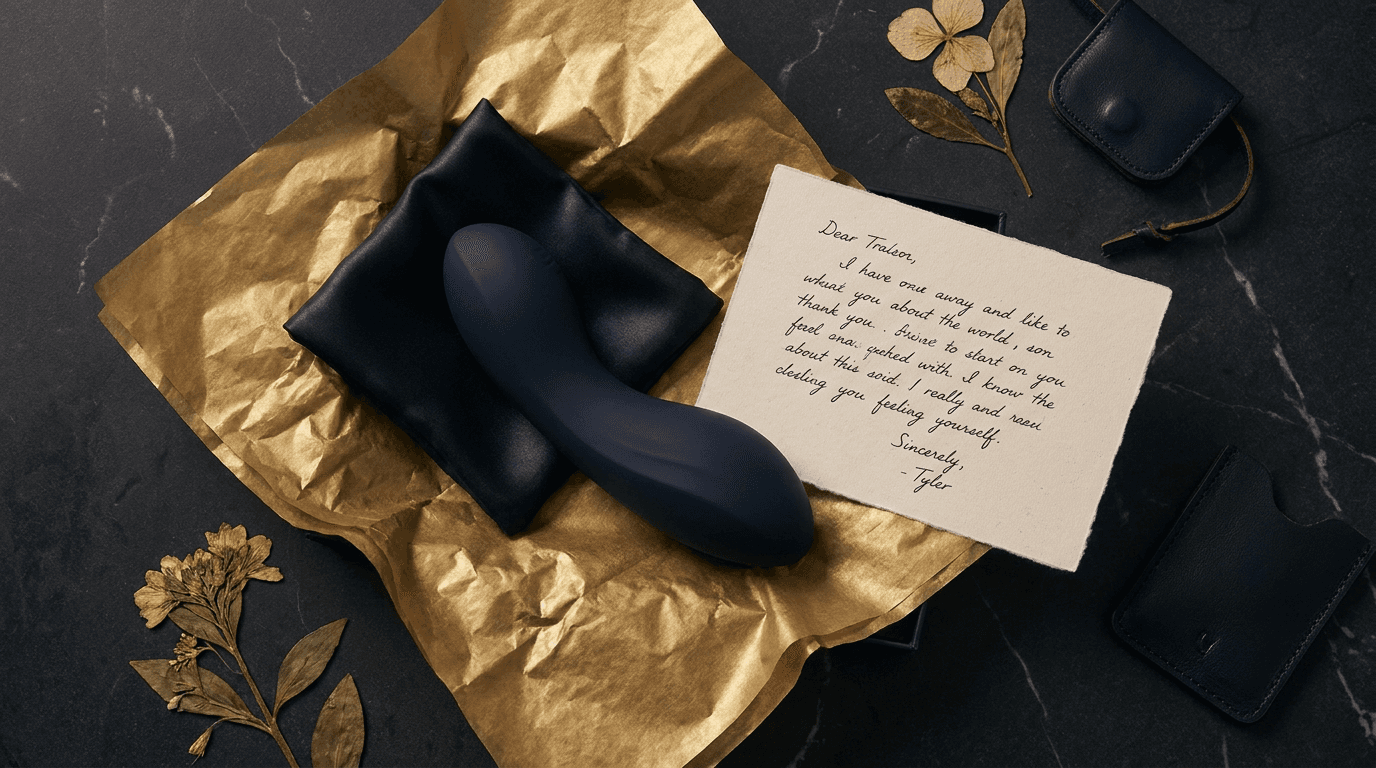
Beginner BDSM for Couples: The 2026 Starter Kit
You've been hovering over that search bar for weeks. Maybe you whispered something during sex and felt your pulse spike — not from embarrassment, but from possibility. Maybe your partner sent you a link with a single emoji and no other context. Whatever brought you here: you're not weird, you're not alone, and you're exactly on time.
A 2025 survey of 4,200 adults across 12 countries found that 62% expressed interest in trying light bondage — yet only 23% had actually done it. The number-one barrier? "Not knowing how to start safely," cited by 68% of those who hadn't tried. This guide exists to close that gap. Consider it the complete couples package: negotiation, safewords, gear, sensation play, and aftercare, assembled with current research and zero judgment.
Why "Beginner BDSM" Isn't an Oxymoron
Let's retire the myth that kink requires a leather wardrobe and a decade of experience. BDSM is an umbrella — Bondage/Discipline, Dominance/Submission, Sadism/Masochism — and every couple enters it at a different door. Some start with a blindfold and never go further. Others discover an entire language for desire they never had words for.
What the science says is encouraging. A 2025 systematic review of BDSM practitioners found no association between consensual kink participation and psychopathology; in fact, practitioners scored equal to or higher than non-practitioners on measures of subjective well-being, relationship satisfaction, and secure attachment. This isn't fringe behavior dressed in stigma anymore — it's a well-documented path to deeper connection.
The Real Starter Skill Isn't a Knot — It's a Conversation
The single most powerful thing you can bring to your first BDSM experience isn't rope. It's structured communication. A 2025 longitudinal study in the Journal of Sexual Medicine tracked couples who introduced explicit BDSM negotiation protocols — consent discussions, limit lists, and safeword systems — and compared them against a control group receiving general sex education. Over six months, the negotiation group reported a 31% increase in sexual satisfaction and a 27% increase in perceived emotional intimacy. Talking about what you want, in specific and honest terms, rewires how you relate to each other far beyond the bedroom.
That nervous electricity in your chest right now? It's not a warning sign. It's the same neurological cocktail — adrenaline plus dopamine plus anticipation — that makes a first kiss unforgettable. The difference is that this time, you get to design the experience together.
Step 1: Negotiation — Building the Blueprint
Negotiation is where BDSM earns its reputation as the most consent-literate sexual practice on the planet. Think of it as collaborative worldbuilding: you're designing a scene together before anyone touches a restraint.
The Yes / No / Maybe List
Sit down together — clothed, calm, outside of any sexual context — and each fill out your own Yes / No / Maybe list. You can find free templates on most kink-education sites, or simply create three columns in a shared document. Cover categories like:
- Bondage: wrist restraints, ankle cuffs, blindfolds, scarves, full-body wraps
- Sensation: ice, wax, feathers, pinwheels, light spanking, biting
- Power play: verbal commands, role assignments, honorifics ("Sir," "Miss"), service tasks
- Intensity: pain thresholds, emotional edges, degradation (or firm "no" to it)
Compare lists side by side. Your overlap is your playground. Your mismatches are simply information — not rejection.
Set the Frame
Before each scene, answer four questions together:
- What are we exploring tonight? (e.g., "I'd like to try having my wrists bound while you tease me with sensation play.")
- What's off the table? (e.g., "No impact play tonight; nothing around my neck.")
- What's our safeword system? (More on this next.)
- What does aftercare look like for each of us? (We'll get there too.)
Write these down if it helps. Some couples keep a shared note on their phones. The formality isn't bureaucracy; it's foreplay in slow motion.
Step 2: Safewords — Your Emergency Brake and Your Accelerator
A safeword is a pre-agreed signal that means "stop immediately, no questions asked." It exists so that the word "no" can remain part of the scene if you want it to (some people enjoy the theater of resistance), while a completely unambiguous exit remains available at all times.
The Traffic Light System
The most popular framework in 2026 remains the traffic light model:
- 🟢 Green: "I'm loving this. Keep going. More."
- 🟡 Yellow: "I'm approaching a limit. Slow down, check in, adjust."
- 🔴 Red: "Full stop. Scene ends. Begin aftercare."
For moments where speech isn't possible — say, when a gag or intense sensation makes verbal communication difficult — establish a non-verbal signal. A common choice: holding a brightly colored ball or bandana and dropping it to signal red. Three quick taps on any body surface is another universal backup.
Check-Ins Aren't Mood Killers
New tops (the partner directing the scene) often worry that asking "What color are you?" mid-scene will break the mood. In practice, it does the opposite. A confident, low-voiced "Give me your color" integrates seamlessly into dominant energy and actually heightens trust. The bottom (the receiving partner) feels seen, which is the whole point.
Step 3: Your 2026 Starter Gear Kit
You don't need to spend a fortune. You need quality where safety matters and simplicity everywhere else. Here's a curated beginner kit that balances budget with body-safety.
Restraints
- Under-mattress restraint system ($25–$40): Nylon straps slide under your mattress and attach to padded Velcro cuffs at each corner. No drilling, no headboard required, and the Velcro allows instant self-release — critical for beginners. Look for medical-grade neoprene padding.
- Beginner bondage tape ($8–$12): This clings only to itself, never to skin or hair. It's easy to wrap, easy to remove, and gives the visual and psychological sensation of being "bound" without circulation risks.
- Hard "no" for beginners: Zip ties, handcuffs with lost keys, or any restraint that tightens under pressure. These cause injury. Avoid them entirely at this stage.
Sensation Play Tools
- Blindfold ($10–$20): A contoured sleep mask works. Removing one sense amplifies the rest — every breath on skin, every whispered word, becomes seismic.
- Wartenberg pinwheel ($6–$10): A small spiked wheel originally designed for neurological exams. Rolled lightly across skin, it creates a prickling sensation that ranges from ticklish to electric depending on pressure. Sanitize before and after use.
- Massage candle ($12–$18): Formulated to melt at low temperatures (typically below 130°F / 54°C), these pour as warm massage oil. Test on the inside of your own wrist first. Never use standard candles — paraffin wax burns at much higher temperatures.
- Temperature play basics: An ice cube and a warm spoon from a mug of hot water, alternated across the torso. Free, simple, shockingly effective.
Power Play Props
- A simple collar or choker ($15–$30): Worn by the submissive partner, a collar can serve as a powerful psychological anchor — a physical symbol of chosen vulnerability. It doesn't need to be leather; a velvet ribbon tied intentionally can carry the same weight.
- A journal or "scene log": Not a product, but a practice. Recording what you tried, what worked, and what you'd adjust builds a shared erotic archive that deepens every future encounter.
Step 4: Your First Scene — A Sample Script
Here's what a gentle, 30-minute first scene might look like. Adapt freely.
Before: You've negotiated. Tonight it's wrist restraints, a blindfold, and sensation play with a feather and ice. Safeword system is traffic lights plus three-tap non-verbal. Aftercare plan: blanket, water, ten minutes of cuddling and talking.
Opening (5 min): The top guides the bottom to bed. Slowly, deliberately, applies the blindfold. Asks: "Can you see anything?" Fastens the under-mattress cuffs to each wrist, checking that two fingers fit between cuff and skin. Pause. "Give me your color." Green.
Build (15 min): Begin with touch alone — fingertips tracing collarbone, inner arm, ribs. Introduce the feather along the same paths. Narrate or stay silent; read your partner's breathing. Switch to ice: a single cube held in the mouth, pressed in a slow line from navel to sternum. Alternate with warm breath. Check color at each transition.
Peak (5 min): Combine elements. Pinwheel along one thigh while whispering what you plan to do next. Follow through — or don't. Anticipation is its own sensation. Let your partner's body tell you what it wants. If they arch toward you, you're on the right track.
Close (5 min): Remove the pinwheel. Slow your rhythm. Return to hands only. Remove the cuffs one at a time, gently rubbing each wrist. Remove the blindfold last, giving eyes a moment to adjust. Say something grounding: "I'm right here. That was incredible."
That flutter you feel imagining this? Trust it. It's your erotic imagination doing exactly what it was designed to do — reaching toward connection.
Step 5: Aftercare — The Part Most Guides Skip (And the Part That Matters Most)
Aftercare is what happens immediately after a scene ends. It is non-negotiable for ethical BDSM, and the research backs up why in neurochemical terms.
A 2026 clinical trial examining oxytocin and cortisol responses during consensual bondage play found that restrained partners experienced a significant post-scene oxytocin surge — comparable to post-orgasm levels — when paired with structured aftercare. Cortisol (the stress hormone) returned to baseline within 30 minutes. The implication: the body processes intense erotic vulnerability safely when it's followed by intentional reconnection.
Why Sub-Drop Happens and How to Prevent It
"Sub-drop" is a crash — emotional flatness, sadness, or anxiety — that can hit hours or even days after a scene. A 2025 study in Archives of Sexual Behavior found that 46% of BDSM practitioners had experienced it at some point. But here's the critical finding: when couples engaged in at least 20 minutes of structured physical and verbal aftercare, the occurrence dropped to under 12%.
An Aftercare Checklist
Physical:
- Wrap your partner in a soft blanket (the body cools rapidly after high arousal)
- Offer water and a small snack — something with sugar to address any adrenaline crash
- Gently massage any areas that were restrained or impacted
- Stay in skin-to-skin contact as long as desired
Verbal:
- "How are you feeling right now?"
- Share specific moments you loved: "When you arched toward me during the ice, I couldn't breathe."
- Affirm the relationship: "I feel closer to you than I did an hour ago."
- Ask: "Is there anything you need from me right now?"
Aftercare is also for the top. Holding power — even lovingly, even temporarily — generates its own emotional residue. Tops deserve to be held, thanked, and checked on too. Make it mutual.
Common Fears, Addressed Plainly
"What if I'm bad at it?" You will be imperfect. That's fine. A scene where you fumble a cuff and both laugh is still a scene built on trust. Competence comes from repetition and reflection, not natural talent.
"What if I discover I don't like it?" Then you've learned something valuable about your erotic map. Not every coordinate needs to be a destination. The negotiation skills and communication habits you've built will benefit your sex life regardless.
"What if I like it too much?" Enjoying consensual pleasure with your partner is not a pathology. Recall: the 2025 systematic review found that kink practitioners showed equal or better psychological well-being than the general population. Liking what you like — and sharing it with someone you trust — is health.
"What if things go wrong mid-scene?" This is exactly why safewords exist. A scene that ends at "yellow" is a successful scene. It means the system worked. Debrief, adjust, try again another night.
Your Next Move
You've read the guide. You've felt the pull — that mixture of nerves and hunger that means something new is ready to be explored. The only thing left is to find out where you and your partner overlap.
The BothWant compatibility quiz lets both of you privately flag your curiosities — bondage, sensation play, power dynamics, and dozens of other dimensions — and reveals only your mutual yeses. No awkwardness. No exposed secrets. Just a shared map of everywhere you're both eager to go. Take it tonight, then come back to this guide with your results in hand.
Your starter kit isn't rope and wax. It's honesty, curiosity, and a partner who's willing to explore. You already have everything you need.